Growing Resilience: The Berry Patch Project Moves Forward
August 2025 — Hartley Bay, B.C.
As Gitga’at Power continues to build a cleaner, more sustainable future through renewable energy, the land surrounding our hydroelectric development is being cared for in ways that reflect community priorities and cultural knowledge. The Berry Patch Project (BPP), now in its second season, is one such effort—establishing native plant life along the 5.7 km hydro access road and helping reestablish traditional food systems in Gitga’at territory. The road has also opened up access to existing plants and their bounty.
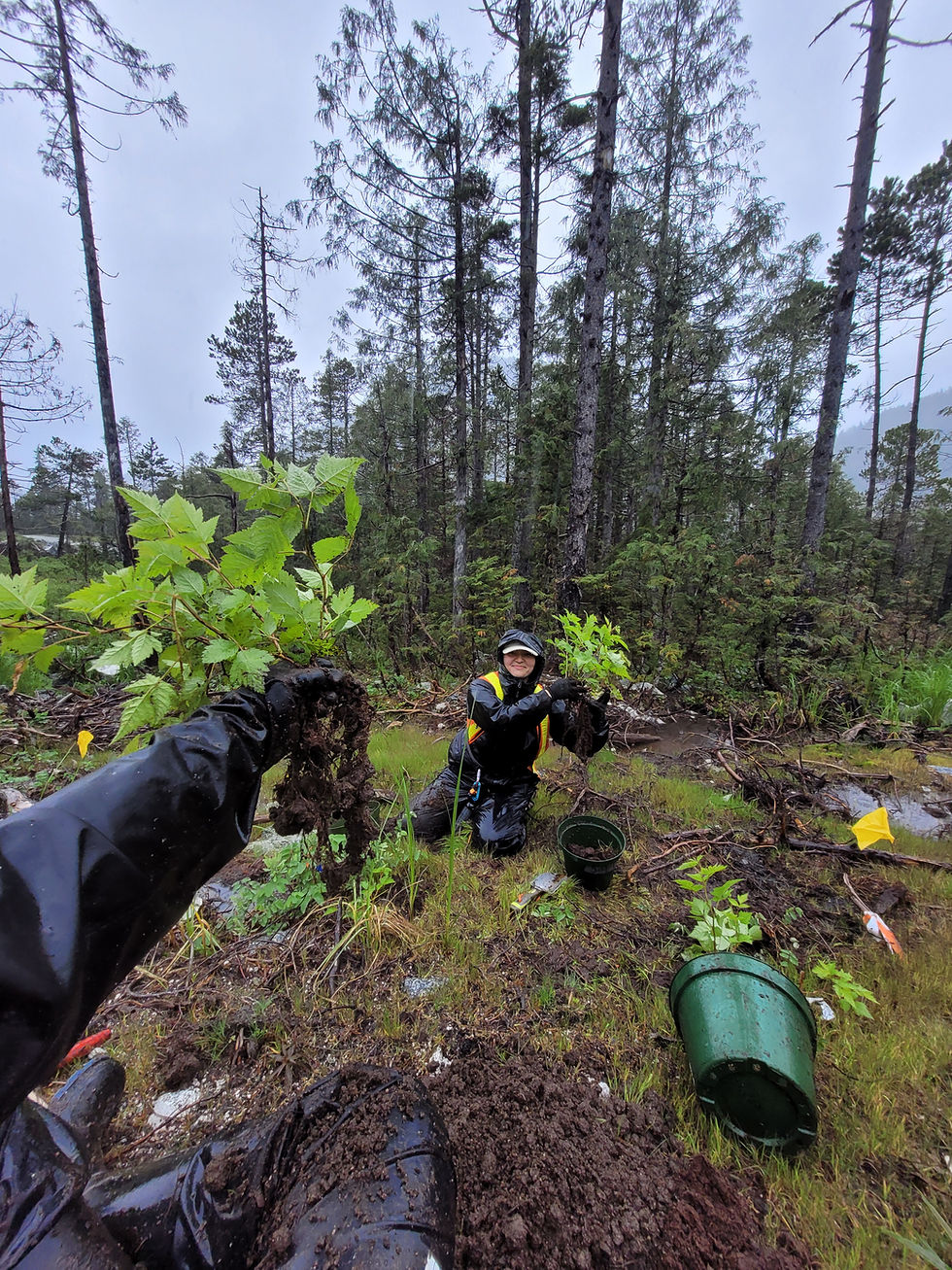
Rooted in local knowledge and guided by Gitga’at elders’ wisdom and stewardship, the BPP was created to revegetate disturbed roadside areas with culturally significant berry plants, including salmonberry (mak’ooxs), fireweed (haas), and bunchberry (k’apk’oop), among others. These species were chosen for their cultural relevance, their ecological value, and their potential to thrive in the challenging conditions of a roadside environment.
Going forward, GOLD will take an active role in making sure the BPP continues to thrive.
Season 1 Highlights: Trial and Growth
In 2024, the project team transplanted salmonberry rhizomes collected from multiple local “mother sites” around Hartley Bay. Over 80 rhizomes were planted across five research patches, with germination success varying between sites. By the end of the season, 32.5% of salmonberry rhizomes had sprouted, with Patch 16 seeing the highest success rate.
Fireweed proved to be a standout species, with a 75% germination rate. Many fireweed plants grew vigorously and flowered by August, attracting pollinators and showing strong potential for roadside planting.
Bunchberry faced more challenges, particularly during a mid-season heat wave, and experienced high rates of above-ground foliage dieback. Still, new underground growth was observed, and bunchberry was even found growing independently in some roadside areas—suggesting limited but promising potential under the right conditions.
Community Patch and Blueberry Trials

Following community feedback that expressed a desire to see more blueberries along the road, the team established a Community Patch using locally harvested Vaccinium species (including oval-leaved and Alaskan blueberry). Unfortunately, these transplants struggled and ultimately did not survive the summer. Environmental stressors like heat, dry soil, and limited root structure proved too harsh for these species under current conditions.
In response, softwood cuttings of dwarf blueberry were started in the greenhouse, and early results are encouraging—50% of cuttings produced healthy roots. This success has sparked new ideas for how Gitga’at youth and Elders might one day harvest berries again along easily accessible trails.
Greenhouse Germination and Experiments
In the community greenhouse, salmonberry rhizomes showed stronger performance than in the field. Nearly 50% germinated in pots filled with roadside soil and local sand. The team also ran a fertilizer experiment to compare commercial and local options like fish and seaweed slurries. While commercial fertilizer (Miracle-Gro) led to the tallest plants, the use of local materials will be explored further with refined methods.
Other species, including bunchberry and salal, were trialed in the greenhouse. Bunchberry showed better performance here than on the roadside, and dwarf blueberry cuttings stood out as a particularly resilient option for future propagation.
Where We Stand Today
As of Summer 2025, the Berry Patch Project has established:
55 living salmonberry plants along the roadside
A growing amount of greenhouse-grown seedlings and cuttings
Key learnings about which species can survive—and which need more time or support
We’ve also learned that roadside berry plants likely won’t produce fruit in time for the hydro project's Commercial Operation Date (C.O.D.) celebrations in 2027, as initial growth is slower than expected. But this doesn't mark a setback—it simply reaffirms that land-based work requires patience, flexibility, and care.
A Living Symbol of Gitga’at Stewardship
The Berry Patch Project is about more than planting berries. It’s about food sovereignty, ecological care, and cultural continuity. By transforming roadsides into places where people, plants, and pollinators can thrive together, we’re reclaiming space—on our terms.
We’re proud of how far we’ve come—and grateful to everyone who has contributed time, knowledge, and care along the way.


Comments